Stainless Steel Line Filter vs Y-Strainer: Differences and Selection
The medium in a pipeline can carry particles formed during production or coming from outside. These particles can damage pumps, valves, measuring instruments and heat exchangers and reduce product quality. Line filters and strainers catch the particles in the line and protect the equipment. In this article we explain the differences between the two products and when each one is preferred.
Why Use a Filter?
- Equipment protection: Pump impellers, valve seals and the closing elements of check valves are easily affected by particles.
- Product quality: In hygienic processes, foreign matter is kept out of the product.
- Maintenance costs: Collecting particles at a single point reduces breakdowns and unplanned stoppages.
Hygienic Angle Line Filter
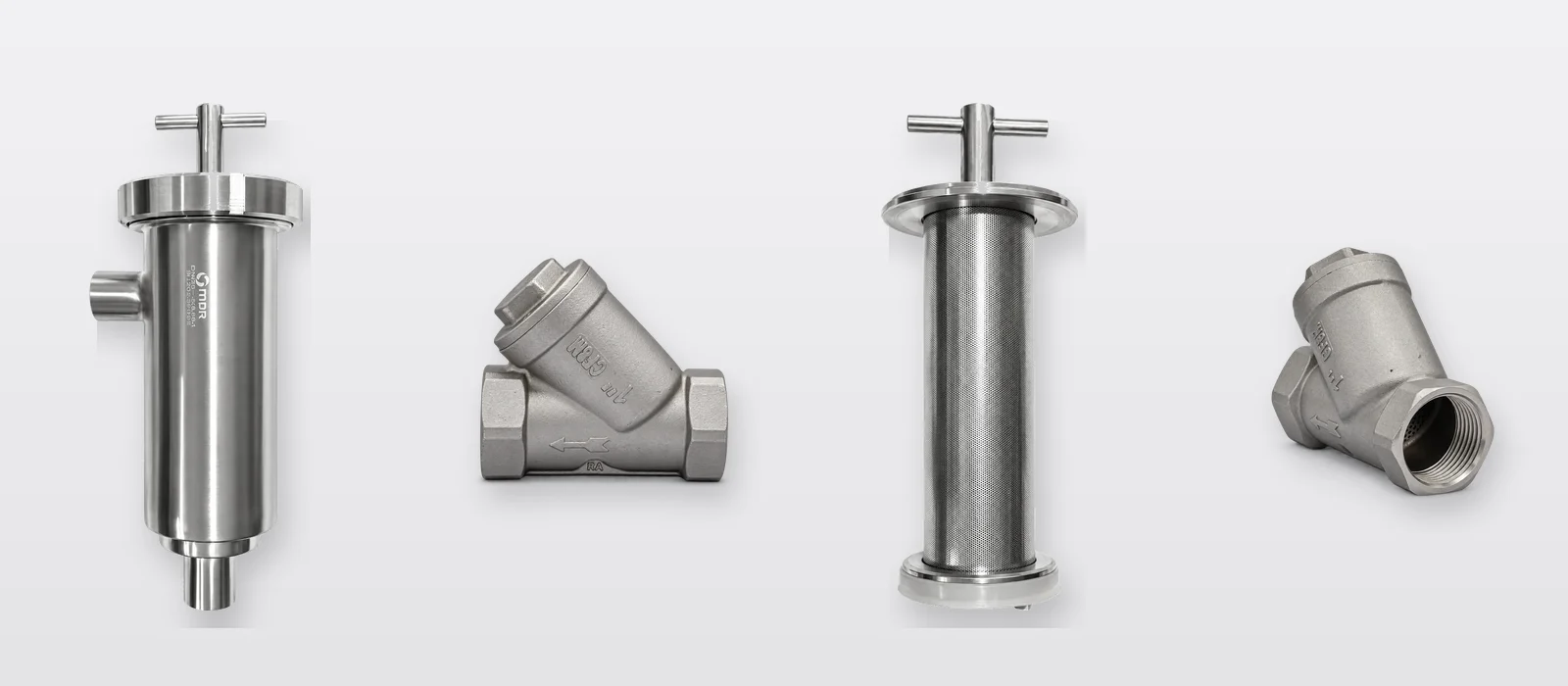
The welded angle line filter is designed for hygienic process lines such as food, beverage, dairy and pharmaceutical production. Its inlet and outlet ports are positioned at 90° to each other; particles are retained as the medium passes through the perforated stainless steel filter element inside the body. The angled design makes it easy to install the filter where the line changes direction.
- Made of AISI 304 or AISI 316L stainless steel to DIN 11850 / EN 10357-A pipe dimensions.
- Internal product-contact surfaces are finished to Ra ≤ 0.8 µm; the external surface has a satin finish.
- The filter element is removed for cleaning by opening the cover.
- Sizes from DN25 to DN100 are listed on the product page.
Y-Strainer
The Y-strainer takes its name from the Y-shaped screen chamber on its body. As the medium flows through the body, the screen inside catches particles, which collect in the chamber. The screen is cleaned by removing the chamber cap. With its compact and durable cast body, it is widely used on industrial water, air and auxiliary media lines.
- It has threaded connections; sizes from 1/4" (DN8) to 4" (DN100) are listed on the product page.
- The arrow on the body shows the flow direction, and the strainer must be installed accordingly.
Line Filter or Y-Strainer?
| Angle line filter | Y-strainer | |
|---|---|---|
| Application | Hygienic process lines | Industrial and auxiliary lines |
| Connection | Welded | Threaded |
| Surface | Internal surface Ra ≤ 0.8 µm | Cast stainless steel surface |
| Size range | DN25 – DN100 | DN8 – DN100 |
| Cleaning | Cover opened, filter element removed | Chamber cap removed, screen cleaned |
In short: the angle line filter is preferred on hygienic lines in contact with the product, the Y-strainer on water, air and utility lines.
Installation and Maintenance Tips
- Install the filter directly upstream of the equipment you want to protect (pump, valve, check valve, measuring instrument).
- Isolation valves before and after the filter allow it to be cleaned without draining the line.
- A clogged filter element reduces flow; set the cleaning interval according to how contaminated the medium is.
- Leave enough space during installation to remove the filter element.
Technical Information and Quotes
The dimension tables and technical drawings of both products are available on the related product pages. You can browse our other products in the Hygienic Products and Industrial Products categories. To choose the right filter for your line together and request a quote, get in touch with us.