Stainless Steel Pipe Types – Bursa Stainless Pipe
Bursa Stainless Pipe Supply Solutions
Piping systems used in industrial plants are critical in terms of durability and corrosion resistance. Bursa stainless pipe solutions provide safe use in the food, automotive, chemical and machinery industries. Products manufactured to high quality standards offer a long service life.
What Is a Seamless Stainless Pipe?
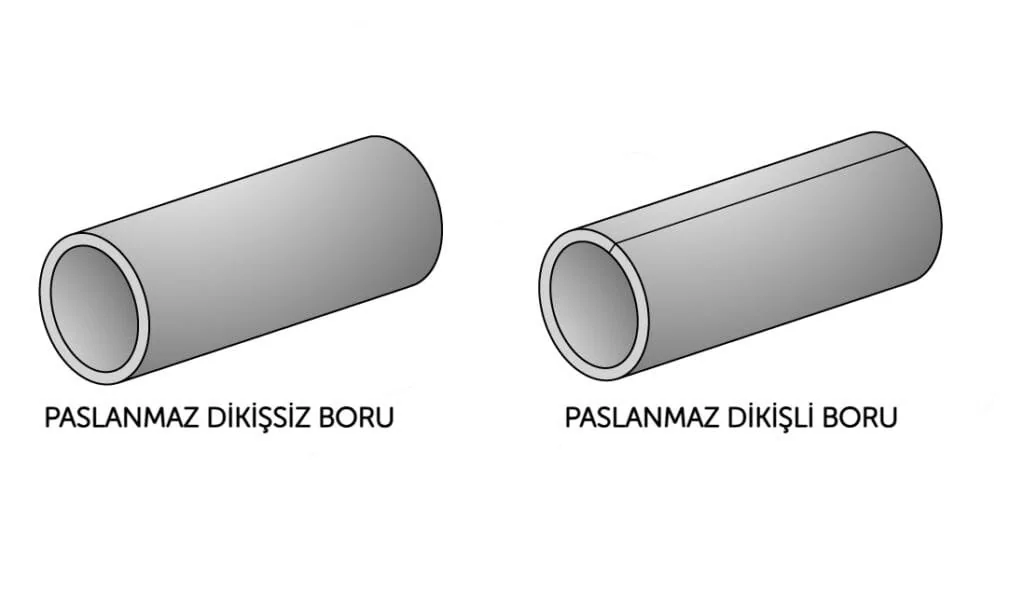
Among the stainless steel pipe types, seamless pipes stand out with their high pressure resistance and superior corrosion resistance. Produced by drawing, these pipes are formed in a single piece and therefore contain no weld seam. This ensures safe use especially in pressurised lines and critical applications.
During production, steel billets are heated and pierced, then rolled to the required diameter. The absence of a weld improves the integrity of the inner surface and creates a homogeneous structure. Thanks to this property they are preferred in sectors such as petrochemicals, power plants, automotive and heavy industry.
Seamless products offer a performance advantage particularly in systems operating under high temperature and pressure. They can also be used safely in lines that require hygiene.
With a very wide range of applications, stainless drawn pipes are generally used in the machinery, shipyard, food and automotive industries. From food to paint, from paint to petrochemicals, stainless drawn pipe is preferred in many sectors for its durability, its high resistance to corrosion and oxidation, and its hygienic properties.
What Is a Welded Stainless Pipe?
Because welding is used during production, welded stainless pipe has a lower pressure resistance than drawn stainless pipe. Production begins by cutting stainless sheets to specific dimensions. The cut sheets are shaped by passing them through a series of wheel-shaped dies. As the sheets reach a round form and advance along the line, they are welded by a machine and turned into pipe. The welded stainless pipes are then annealed to increase their flexibility and machinability, cut to the required lengths and, after the weld areas are ground, made ready for use.
Welded pipes, whose pressure resistance is lower than drawn pipe due to the welding process, are generally used in lower pressure lines and machine installations. Welded pipes are also widely used for decorative purposes in many areas of our daily lives. Because of their price advantage, welded pipes are preferred far more often than drawn pipes.